

2 days online followed by 2 days in person
• November 24, 29 – Online
• December 1, 2 – In Person
Asking questions is the central act of transformation. Questions are the key that causes the secret doors of the psyche to swing open.
Clarissa Pinkola Estes
Through one lens every aspect of our lives is subject to impermanence, contingency, change. Plausibly this has always been so, but it can seem like this is gathering pace. Personally, locally, and globally, the challenges of climate change, of artificial intelligence, of resource limitations, can pull us in multiple directions.
This Group Relations Conference is an experiential learning event. Whether you are in a leadership role, a student, or simply a curious citizen, we invite you to explore the experiences, inspirations, frustrations, and opportunities of seeking to collaborate together, and finding authority in the current climate.
ABOUT THE CONFERENCE
Transitions and Transformations
If you don’t like something, change it. If you can’t change it, change your attitude.
Maya Angelou
In times of transition and transformation how do we plot our path? How to find agency when faced with tumult? How to hold on to what we hold dear and wish to cherish? How to learn to let go of things no longer felt necessary?
And how, as we seek solutions, do we find a stance that keeps us attuned to the different voices around us? How do we build the coalitions that allow progress? Are we prepared to take the risk? How do we create sustainability together?
These are some of the questions that can be explored in this conference.
What is it?
This Group Relations Conference is an experiential learning opportunity. It aims to help you:
- Develop insight into how you take up your role in complex settings.
- Build your understanding of group and social processes.
- Encounter how others take up their role in groups.
- Explore the dynamics of change.
- Consider broader cultural processes that impact on group and system functioning.
Who is it for?
The Conference is suitable for anyone curious about the impact of self on group, and group on self. You may be in a leadership role, an executive, a student of the human sciences (business administration, social science, psychology, psychotherapy), a community organiser, or simply a citizen seeking to explore the context in which we live, learn and grow. No previous experience is required.
What happens in a Group Relations Conference?
You cannot help but learn more as you take the world into your hands. Take it up reverently, for it is an old piece of clay, with millions of thumbprints on it.
John Updike
Group Relations is an approach to group work, with its roots in system-psychodynamic thinking. A Group Relations Conference consists of a number of group sessions, some with pre-allocated membership, some with self-forming groups. Consultants work to support learning by highlighting whole group dynamics. This may include attention to “beneath the surface” processes, blind spots, hidden meanings, and the emotional realities that lie behind our everyday talk.
The first Group Relations Conference, the Leicester Conference, was held by The Tavistock Institute in 1957. Today, they are hosted worldwide, by a wide variety of organisations, committed to the simple vision of learning through the experience of being together.
Stepping into the conference might initially feel like joining any other public meeting. There are many familiar features: a handbook sets out the programme, there are the usual formalities of registration, then an opening welcome event at which the staff are introduced, and the conference director makes some opening remarks.
But then something unusual happens. A space opens up which is not filled by a sequence of pre-determined speeches. There may be silence, there may be reflection or suppressed tension, or someone finds the courage to speak. The essential framework is the space denoted by time and task. Within this there is the possibility of exploration.
At its simplest level a group is a collection of people who’ve come together to engage in some shared purpose or task together. This inevitably means that people find themselves taking up, or being pushed into roles. Some of these roles may be task-focussed: a group leader, a team player, a follower. Some of these may not apparently be so: a group saboteur, a group sceptic, the silent participant, and so on.
There may be a feeling that we’ve been here before. After all, by adulthood, all of us have been in many groups: family constellations, school situations, social groups, voluntary associations, work teams. What is the combination of personal history, of how we read what is happening, and of what is “given” to us by the group, that leads us to play the parts we play in these contexts?
This is the invitation to learn that is present in a Group Relations Conference. There may be surprises ahead as we confront how we influence, or fail to influence others, and how we deal with what others tell us about ourselves. To the extent that the group situations seem “familiar” to us, there is the capacity to review group dynamics from other phases of life that we took as set in stone.
In sum, then, a Group Relations Conference is designed to provide a setting for deep learning about self, about role, and about group in the context of organisation and society. This inevitability involves encounters with issues of authority, power, leadership, followership, and indeed the themes of this conference: transition, transformation, diversity, risk, and sustainability. No previous experience is required. Only curiosity and a desire to learn.
Two Pathways
The conference offers two opportunities, Pathway A and Pathway B (Training).
Pathway A is open to everybody. You do not need to have any earlier experience of a group relations conference. This pathway includes membership of all conference events, including small study group, large study group, organisational events and review groups.
Pathway B (Training) is open to those with two or more earlier experiences of participation in a group relations conference. In addition to membership of a range of conference events, this includes further specialist groups for developing consultancy approaches and opportunities to practice these approaches.
TRAINING GROUP
This year the conference includes a Training Pathway for those experienced in group relations conferences who wish to develop their consultancy skills. The Training Group will have some separate events with opportunities to develop and practice consultancy approaches. The Training Group is open to individuals who have completed two previous group relations experiences and is limited to 6 places.
Conference Staff Team





What they said about us:
Key words from evaluations of our April 2023 OPUS Group Relations Conference

Conference Information
Times and Venue
Day 1: November 24th
Zoom online:
11:00 – 20:15
Day 2: November 29th
Zoom online:
14:00 – 20:15
Day 3: December 1st
London:
12:00 – 20:15
Day 4: December 2nd
London:
09:30 – 16:15
All London Times, (UTC +0)
The Venue is central London, 5 minutes’ walk from Kings Cross/St Pancras International Station:
Voluntary Action Islington
200A Pentonville Road
London N1 9PJ
Accommodation is not provided.
Refreshments and Evening Meal are provided on December 1st 2023.
Refreshments and Buffet Lunch are provided on December 2nd 2023.
Conference Fees:
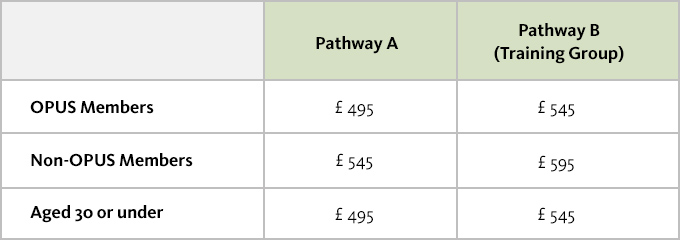
Pathway A: Open to all
Pathway B: Open to individuals who have completed two previous group relations conferences (limited to 6 places).
Closing Date for Application: 17th November 17:00 London time (UTC+0).
There is a limit of 36 places.
Cancellation Terms
Cancellations received by 3rd November 17:00 London time (UTC +0) are 100% refundable.
Cancellations received by 10th November 09:00 London time are 50% refundable.
No refund can be given on cancellations received after 17th November.
HOW TO CONTACT US
For more information or if you have any questions, please email us at opusgrouprelations@gmail.com
We look forward to welcoming you to the conference!
About OPUS: An Organisation for the Promotion of Understanding in Society
OPUS is a member-led charitable foundation, which aims to promote understanding in society. Founded in 1971, it stages an annual programme of conferences, listening post events, consultancies, and group relations events. Visit www.opus.org.uk
In 2023 OPUS events have included:
- Climate and Democracy: Listening Post Event
- Does your Computer have an Unconscious Mind?: Talk and Discussion
- Group Relations as a Fractal of Society: Lecture
- Journeys into the Unknown – Re-acting , Responding, Relating: Group Relations Workshop
- Practice Supervision Groups
- The Covid Trail: Book Launch
- The Elephant in the Room: Book Launch
- The Many Myths of Money: Talk and Discussion
- Turbulent Transitions – Living through a Time of Crisis: Conference
- We Don’t Speak of Fear: Book Launch
- Ukraine One Year On – Reflections: Talk and Discussion